At sea transportation of dangerous goods via containership is a complex procedure, requiring detailed understanding and knowledge of the relevant regulations. In all aspects of dangerous goods handling, from identification to packaging, marking, labeling, and documentation need some careful consideration.
Before commencement of loading shipmaster must consider the effect of any given parcel of DG cargo upon other cargo carried on board, as
well as possible effects of the cargo on the structure of his vessel.
Clear guidelines apply to the stowage
and segregation of Dangerous Goods and in some cases may require particular commodities to be carried
in completely separate holds. The interaction of two cargoes will not occur if the packaging of that
cargo remains intact. However, the Master must always consider the possible effect should the cargo escape
for any reason and should not restrict his consideration to those cargoes which are listed in the IMDG Code.
Procedures and guidelines for stowage and segregation of dangerous cargo shall be adhered to
additionally:
- Every dangerous cargo shipment shall be made in line with IMO policy and be accompanied by required documentation. DG cargo with restricted/prohibited UN numbers shall not be accepted for shipment unless under special circumstances express permission is obtained from the company.
- All DG containers must be checked for proper label/placard as required by the IMDG code. A stock of spare labels/placards must be kept on board.
- DG containers must be checked for condition prior loading and leaking or damaged containers posing a hazard, shall be rejected.
- It must be ensured that all DG containers are loaded in the planned stow position. Any discrepancies shall be brought to the notice of the Terminal planner / Central planner and/or local agent as required.
The final condition may be accepted only if meeting all stowage and segregation requirements; else it must be corrected by discharging/shifting concerned container(s).
- The requisite day/night signals for vessels carrying / loading / discharging dangerous cargo shall be displayed.
- When handling/carrying dangerous cargo on board smoking shall strictly not be allowed other than in designated smoking areas. Signs/placards shall be appropriately displayed at the gangway and on deck.
- Location and properties of dangerous cargo shall be considered when carrying out any special work onboard such as hot work etc.
- Obtain container packing certificate:
Certificate indicating correct loading of a dangerous goods container and the observance of the regulations set out in the IMDG Code (International Maritime Dangerous Goods Code). The container packing certificate is issued by the person responsible for packing the container.
- Other precautions shall be taken when handling dangerous cargo shipments as warranted by good seamanship, SOLAS, MARPOL, IMDG code, local and national regulations.
- Further guidance for handling D.G cargo is contained in IMDG Code vol 1, 2 & supplement.
DG stowage :
Particular caution is to be exercised when stowing dangerous cargo on board the vessel.
Any dangerous cargo presented for loading must be accompanied by a proper manifest and declaration as required by international regulations. Further, this DG cargo must be acceptable for carriage as per IMDG code guidance. The reference here is made to the list of UN numbers restricted/prohibited for carriage on board particular vessels.
After confirming the acceptability of the DG cargo, the plan must be checked for proper stowage and segregation. Although terminal and central planners should provide proper stow of DG cargo, the final responsibility always lies with the Master.
Reference shall be made to vessels Document of Compliance with special requirements for ships carrying dangerous goods for confirming that proposed DG classes are acceptable for stowage in planned locations onboard.
Specific storage requirements for DG cargo
(e.g. Clear of living quarters OR if under the deck, in a mechanically ventilated space, etc) may be verified from individual entries of dangerous goods list in the IMDG Code.
DG segregation shall be verified for compliance with the requirements of the IMDG code.
Caution must be exercised when using vessel stowage planning software for this purpose as it may or may not have comprehensive means of checking for bad stowage & segregation against the latest international requirements. It is advisable to manually check for compliance.
Segregation
The greatest care should be taken to ensure that incompatible substances are never stowed together in
the same compartment or container. The IMDG Code classifies such substances according to the principal
hazard, but not all substances of a particular class are necessarily compatible (e.g. Class 8 where a violent
reaction may take place between acids and alkalis).
Careful consideration should be given to all other commodities (and their packaging) to be stowed with
hazardous substances to ensure against dangerous interaction occurring. For instance, non-hazardous cargo
packed with straw, wood, wool, or other combustible materials should not be bestowed with Dangerous Goods.
Substances which react with water must not bestowed with items having a water base.
Foodstuffs must not, as a general rule, be packed with Dangerous Goods.
Segregation requirements of the IMDG Code and any other local/national regulations must be strictly adhered to.
One must be aware that even DG cargoes belonging to the same class may have segregation requirements amongst them.
A good example is that of alkalis requiring to be separated from acids whereas both acids and alkalis may belong to IMO Class 8. Such segregation requirement will not be found in the segregation tables of the IMDG code and only individual entries of the dangerous goods list in the code indicate the requirement.
DG Stowage On Deck
Dangerous Goods stowed on deck must be properly secured, having regard both to the nature of the
packages and the weather conditions liable to be experienced. Adequate security can be obtained employing temporary structures made by using bulwarks, hatch coamings, and bridge bulkhead, the structure being
closed utilizing portable angles bolted to bulwarks and hatch stiffeners. The cargo so stowed should
be further secured through overall lashings or nets. Unless so stowed or secured by some equally
satisfactory methods bulky packages should be lashed individually, preferably with wire rope.
Stowage should be such as to provide safe and satisfactory access to the crew's quarters and all parts of
the deck required to be used in the navigation and necessary work of the ship, with sufficient space for the
crew to work clear of the goods concerned. Dangerous Goods stowed in wells should not be stowed above
the height of the bulwarks, and cargo which, because of its nature, is liable to damage hatch covers or their
seals should not bestowed on the hatch.
Where deck cargo of an inflammable nature is carried, special precautions must be taken to prevent
smoking or the use of naked lights in the vicinity of the cargo. Notices should be prominently displayed to
that effect. Substances liable to give off inflammable or poisonous vapors should be stowed away from
intake ventilators.
In ships carrying passengers, Dangerous Goods may not be stowed in any part of the decks available for
passengers or near passenger accommodation.
In the case of combustibles, care must be taken to avoid the risk of ignition which may arise from electrical
short circuits or old electric cables.
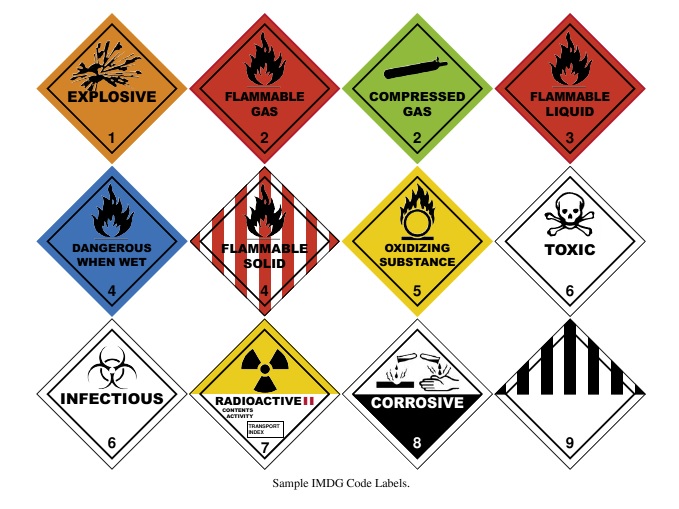
IMDG code levels
Dangerous goods classes — Classes of dangerous goods according to SOLAS (Chapter VII,
Part A), the IMSBC-Code and the IMDG-Code, are as follows:
CLASS 1 — Explosives
Division 1.1 Substances and articles which have a mass explosion hazard.
Division 1.2 Substances and articles which have a projection hazard but not a mass explosion hazard.
Division 1.3 Substances and articles which have a fire hazard and either a minor blast
hazard or a minor projection hazard or both, but not a mass explosion
hazard.
Division 1.4 Substances and articles which present no significant hazard.
Subdivision 1.4S contains substances and articles so packaged, or designed, that any
hazardous effects arising from accidental functioning are confined within the package unless
the package has been degraded by fire, in which case all blast or projection effects are limited
to the extent that they do not significantly hinder fire-fighting or other emergency response
efforts near the package.
Division 1.5 Very insensitive substances which have a mass explosion hazard.
Division 1.6 Extremely insensitive articles which do not have a mass explosion
hazard.
CLASS 2 — Gases, compressed, liquefied or dissolved under pressure
Class 2.1 Flammable gases
Class 2.2 Non-flammable, non-toxic gases
Class 2.3 Toxic (poisonous) gases
CLASS 3 — Flammable liquids
Flammable liquids are grouped for packing purposes according to their flashpoint, their
boiling point, and their viscosity.
CLASS 4 — Flammable solids; substances liable to spontaneous combustion;
substances which, in contact with water, emit flammable gases
Class 4.1 Solids having the properties of being easily ignited by external sources,
such as spark and flames, and of being readily combustible, or of being
liable to cause or contribute to a fire or cause one through friction.
Class 4.2 Solids or liquids possessing the common property of being liable
spontaneously to heat and to ignite.
Class 4.3 Substances which, in contact with water, emit flammable gases.
CLASS 5 — Oxidising substances (agents) and organic peroxides
Class 5.1 Substances which, although themselves are not necessarily combustible,
but may, either by yielding oxygen or by similar processes, increase the risk
and intensity of the fire in other materials which they come into contact with.
Class 5.2 Organic peroxides
CLASS 6 — Toxic and infectious substances
Class 6.1 Toxic substances liable either to cause death or serious injury or to harm
health if swallowed or inhaled, or by skin contact.
Class 6.2 Infectious substances.
CLASS 7 — Radioactive materials
CLASS 8 — Corrosive substances
Substances, which, by chemical action, will cause severe damage, when in
contact with living tissue or, in case of leakage, will materially damage, or
even destroy, other goods or the means of transport. Many substances are
sufficiently volatile to emit vapor irritating to the nose and eyes.
CLASS 9 — Miscellaneous dangerous substances and articles
Further reading: International Maritime Dangerous Goods Code.
Related articles
Required Documents For Stowing Dangerous cargo
DG cargo handling Procedures & Guidelines
Container handling additional guideline:
Containership cargo stowage and planning
Stacking Weights Restrictions
Lashing strength calculation
Dangerous goods stowage and segregation
Reefer Container Stowage
Out of Gauge Container Stowage
Special Container Stowage
20 or 40 or 45 feet Compulsory Stowage Locations
Irregular Stowage of Containers
Over-stow of Containers
Hatch Cover Clearance (High cube containers Under Deck )
Other matters regarding cargo stowage as necessary
How to load maximum number 20 feet container on deck ?
What are the extra precaution should be taken prior loading a 45 feet container on deck ?
Container damage in ''2 in 1'' cargo Operation
Modern containership & loading of various container types
How to load containers coming in different forms/sizes
Our additional pages contain somewhat larger lists of resources where you can find useful informations

Other info pages !
Ships Charterparties Related terms & guideline
Stevedores injury How to prevent injury onboard
Environmental issues How to prevent marine pollution
Cargo & Ballast Handling Safety Guideline
Reefer cargo handling Troubleshoot and countermeasures
DG cargo handling Procedures & Guidelines
Safety in engine room Standard procedures
Questions from user and feedback Read our knowledgebase
Home page
ShipsBusiness.com is merely an informational site about various aspects of ships operation,maintenance procedure,
prevention of pollution and many safety guideline. The procedures explained here are only indicative,
not exhaustive in nature and one must always be guided by practices of good seamanship.
Site Use and Privacy - Read our privacy policy and site use information.
//Home //Terms and conditions of use
Copyright © shipsbusiness.com All rights reserved.
