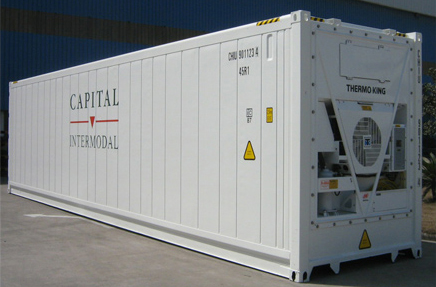
Fig :Reefer Container
The delivery/return air differential will, in most cases, narrow as the continuous circulation of air, being cooler than the cargo, brings the cargo temperature down towards the desired level. Any rise in return air temperature will be arrested as the refrigeration unit begins to run in standard operational mode.
When the stuffing temperature is higher than the stipulated carriage temperature, the refrigeration unit will cool down the surface layer of the cargo relatively quickly (within days). However, the center of the stow will not reach the desired temperature for a considerable period.
The temperature of a cargo stuffed into a refrigerated container should not, in general, deviate by more than 3 degrees C (5 degrees F) from the named carriage temperature. Chilled cargo (excluding bananas) should not deviate by more than 0.4 degrees C (1 degree F). This does not mean that even these differences should be encouraged; the objective is to receive and deliver the cargo at the carriage temperature.
Over-Tempreture Reefer Acceptance Guidelines
a) Temperature-controlled loads are considered “Over-Temperature” (“Hot Loads”) if they have varied from the maximum acceptance temperature set by the Charterers.
However, use the available historical data, especially return and supply air temperature, relative to specific load to determine that the temperature is falling towards setpoint temperatures.
b) Loaded containers varying more than the above-outlined temperatures should not be received at a terminal for loading to a vessel without prior approval from the Container Operator.
c) If onboard a vessel, a unit is found to be "over-temperature," the container operator should be notified immediately using Reefer Container Trouble Report. Where instructed by the Charterers, the vessel's crew shall take action to correct the temperature of the unit by returning it to the proper set temperature.
Reefer Spare Parts
a) Each ship shall carry a designated pool of spare parts if provided by the charterers.
b) The container operator shall be responsible for supplying an initial set of any additional specific parts they require to be added to the vessel spare parts pool.
c) If a container operator introduces a new or different temperature control unit model, he is responsible for providing the initial set of any additional spare parts specific to the unit required for the vessel spare parts pool.
d) If a container operator phases out of a temperature-controlled unit he shall be responsible for collecting or requesting disposal of the relevant parts from the vessel's spare parts pool.
e) The Container Operator shall supply refrigerant gas and oil.
f) The vessel shall be responsible for the onboard spare parts' inventory recording and is responsible for notifying the container operator to replace the spare parts consumed.
g) The Container Operator (or B/L carrier) shall replace all parts used from the vessel's pool for repair to their specific unit in the form of new parts or monetary reimbursement. The vessel shall replace any spare part that is missing and cannot be associated with a repair by specific unit number repaired.
Unless instructed otherwise by charterers, the Container Operator has to receive the Spare Parts Replacement Order no less than five working days before arrival. If less, the Container Operator can decide if the supply of any parts, along with the container, is possible. It is the Container Operator's responsibility to advise the vessel when replenishment of spare parts will take place and the date of delivery.
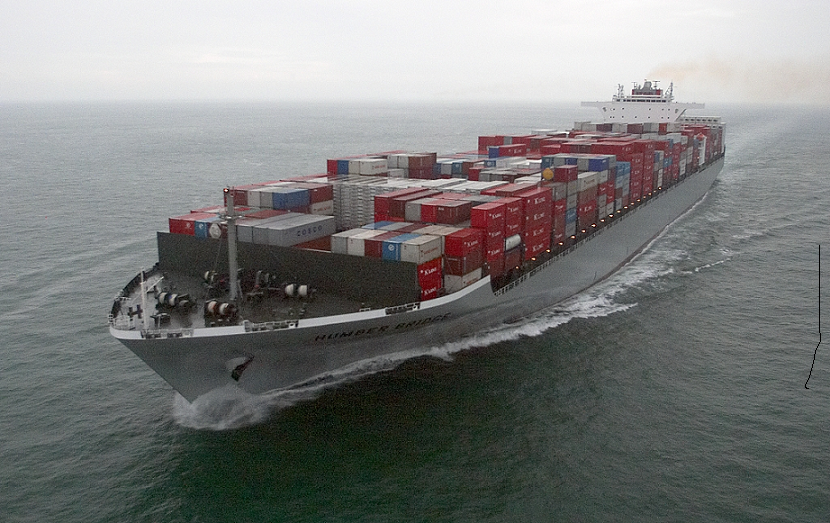
Fig :Container ship at sea
h) The vessel shall make a written request for any replacement parts. The request for replacement parts shall include the following information.
- Vessel’s Name
- Port Arrival Date
- Refrigeration Unit Manufacturer’s Name
- Part Number
- Part Description
- Quantity Required
- Number of the container which the inventory was used on
- Container Operator
i) Replenishment of spare parts should detailed within the charterparty and be made on an exchange basis (failed parts for new parts), therefore, failed parts, especially those which are repairable or can be re-built, shall be delivered to the container operator, replenishing the part at the time of receiving new parts.
j) The Container Operator shall supply the partlow chart to the vessel and the vessel shall assist to replace the partlow chart when it is over-run. The used partlow chart is to be returned to the Container Operator at the port of discharge. Sufficient blank partlow charts are to be placed onboard by the container operator.
Reefer Container Shipment
Procedures and guidelines for stowage of reefer containers shall be adhered to. A reefer container list or manifest must accompany every reefer container proposed for shipment. Additionally read our article on:
- Reefer cargo Handling In Port
Reefer containers shall be plugged in and supplied with ships power as soon as practicable after loading. In case it is to be done by shore hands, ships crew shall still closely monitor the operation and confirm that all reefer containers are supplied with power earliest after loading....
- Reefer cargo care at sea
At sea, all reefer containers shall be monitored by checking physically at least twice daily (weather permitting). All monitored data for each reefer container on board shall be entered in a reefer monitoring log and retained for three years. Some reefer containers with special cargo (e.g., VIP cargo) come with instructions for more frequent monitoring and reporting. Such instructions shall be strictly followed.
....
- Commodities Shipped In Reefer Containers
Some cargoes may require controlled humidity (e.g. flower bulbs). In such cases, many refrigeration units are only capable of reducing humidity within the cargo space, and the settings should be applied accordingly.
....
- Reefer Cargo Temperature Recording
A Partlow recorder registers temperature on a pressure-sensitive circular chart over 31 day period. If the voyage transit is expected to exceed 31 days, care must be taken to ensure charts are replaced before expiry. The first chart should be placed underneath the new chart to build up a complete temperature record for the entire voyage up until arrival at the final destination.
.....
- Reefer Cargo Maintaining Records
Monitoring the digital & chart temperatures of all reefer containers at least twice a day. Daily reefer container temperature checklists should be maintained, and printouts from monitoring unit should be preserved.....
- Reefer Cargo Care During Sea Transit
Reefer containers usually have their own refrigeration unit, with an air or water-cooled heat exchanger. They have a data logger to record the temperature. The logger may be in the form of a Partlow chart or a digital logger. They usually contain high-value cargo, and any damage to cargo would likely result in substantial claims......
feminized seed.
- Reefer Cargo Defrosting
During the operation of a refrigeration unit, a layer of ice will form on the evaporator coils depending on the temperature set, the temperature of the cargo, the amount of fresh air ventilation and the cargo humidity.
The unit periodically enters a phase where heat is produced by a series of electrical bars, allowing defrosting to occur. At such times, all fans are turned off automatically to prevent heat from entering the cargo compartment. ....
- Basic check item prior stowing Reefer Cargo
Stowage location of reefers must be checked against vessels reefer receptacle locations. In case reefer containers must be loaded in random locations, it must be confirmed that monitoring and repair will be possible during the voyage, and that vessel has sufficient extension cables for providing power. ....
Container handling additional guideline:
Containership cargo stowage and planning
Stacking Weights Restrictions
Lashing strength calculation
Dangerous goods stowage and segregation
Reefer Container Stowage
Out of Gauge Container Stowage
Special Container Stowage
20 or 40 or 45 feet Compulsory Stowage Locations
Irregular Stowage of Containers
Over-stow of Containers
Hatch Cover Clearance (High cube containers Under Deck )
Other matters regarding cargo stowage as necessary
How to load maximum number 20 feet container on deck ?
What are the extra precaution should be taken prior loading a 45 feet container on deck ?
Container damage in ''2 in 1'' cargo Operation
Modern containership & loading of various container types
How to load containers coming in different forms/sizes
Our additional pages contain somewhat larger lists of resources where you can find useful informations
 Other info pages !
Ships Charterparties
Other info pages !
Ships Charterparties Related terms & guideline
Stevedores injury How to prevent injury onboard
Environmental issues How to prevent marine pollution
Cargo & Ballast Handling Safety Guideline
Reefer cargo handling Troubleshoot and countermeasures
DG cargo handling Procedures & Guidelines
Safety in engine room Standard procedures
Questions from user and feedback Read our knowledgebase
Home page
ShipsBusiness.com is merely an informational site about various aspects of ships operation,maintenance procedure,
prevention of pollution and many safety guideline. The procedures explained here are only indicative,
not exhaustive in nature and one must always be guided by practices of good seamanship.
Site Use and Privacy - Read our privacy policy and site use information.
//Home //Terms and conditions of use
Copyright © shipsbusiness.com All rights reserved.