How to Calculate Lashing Strength for a Containership While Encountering Bad Weather?
Due to the nature of their trade, container ships are required to keep to very tight
operating schedules. Maintaining the schedule is an integral part of the liner trade.
As a result, these ships have potent engines, not only to provide the high speeds
required, but also to enable speed to be maintained during bad weather.
The consequence is that, at times, container ships can be driven hard. When ships are
driven hard in bad weather, the loads on the lashings can be severe.
Many load components are arising from a ship’s motion. These are discussed below.
Ships’ structure:
The combined weight of a stack of containers may amount to a total downward force on the
tanktop, through each container corner casting, of up to 100 tonnes. When four container
corners are placed close together, such as at the mid-hold position when carrying 20-foot
containers, the total local load on the tanktop maybe four times this load.
During classification, the strength of the ship’s structure to support containers is verified
and approved. It includes an assessment of the strength of the tank top, the cell guides and deck, the strength of the hatch covers, lashing bridges, pedestals and the fixed fittings
associated with the container stow.
It is important to carry containers within the loading conditions imposed by the classification
society. Container loads should never exceed the limits set down in the ship’s loading
manual.
Container strength and ship motion:
Although a ship has six degrees of motion, it is roll, pitch, and heave, which produce the
most significant contributions to the forces on a container stow. Surge is important for road
and rail transportation, and containers are designed with this in mind.
The motion of a ship in irregular seas is itself irregular and is impossible to predict accurately. Consequently, when calculating accelerations on a stack of containers, the natural
cyclic response is assumed in association with assumed maximum amplitude.
Empirical formulae for maximum amplitude and period of response are defined in the
Rules and Regulations for the Classification of Ships by Lloyd’s Register. The rolling motion
is dominant in the calculation of forces, but rolling must be considered in association with
the other components of the ship’s motion to establish the largest likely combination of
forces that the stow may experience.
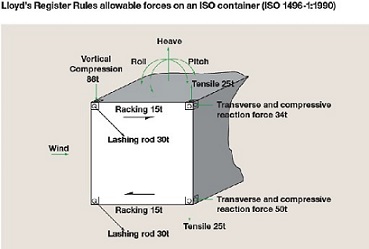
Lloyds Register rules allowable
Forces on an ISO container
For calculation purposes, the forces acting on a container may be resolved into components
acting both parallel to and perpendicular to the vertical axis of the container stack.
Gravity acts vertically downwards and, therefore, when the stack is inclined at maximum
roll or pitch, there are force components of static weight acting both parallel to, and with,
the vertical axis of the stack. The dynamic components of force are vectors. These are
combined algebraically with the static components.
Lashing strength calculation software:
Lashing strength of deck cargo shall be ascertained by using the appropriate lashing strength calculation software where provided.
All resulting values for lashing strength must be within the tolerance limits prescribed by the vessels classification society.
Lashing strength calculation software provides alarms/highlights for containers that are affected by excessive forces. Such a situation may be corrected by adjusting the vessels
Ballast / Fuel condition or by advising Terminal planner / Central planner and having the cargo stow plan modified.
In case any anomaly/alarm is noticed, the Master shall notify all concerned parties and have the condition corrected at the earliest prior departure or the next port as instructed by the Vessel operator / Central planner. In such case, the MasterMaster shall also take this special case into account during maneuvering in heavy weather.
If lashing strength calculation results are exceeding tolerance limits, failure of lashing gear, or failure of the container itself may occur. The probability of this happening is highly enhanced in inclement weather and attendant heavy rolling, pitching, or heaving.
Each lashing gear component has a safe working load and is likely to fail if forces exceed this value. Failure of lashing gear components will then, besides freeing restraints, also likely result in forces on containers exceeding tolerance limits.
Sea freight containers are designed to withstand a defined minimum racking force, side wall racking force, vertical compression, vertical tension, corner post and shearing force at twist lock.
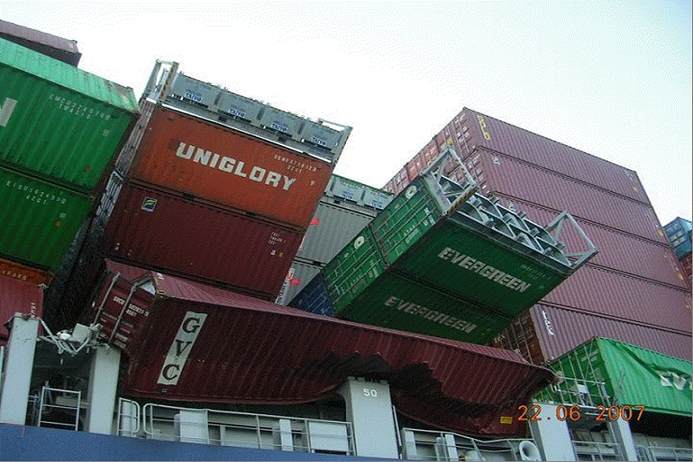
Stowfall due improper lashing
Forces exceeding these defined minimum values (tolerance limits) will likely result in structural damage or collapse of the container. If one container in a stack collapses, it is likely that the entire stack will collapse.
A lashing bridge is a fixed structure while a hatch cover will move when a ship rolls and
pitches. The effect could be that a lashing from a lashing bridge becomes slack or
takes an excessive load.
A hatch cover is designed to move as the ship bends and flexes. A container stowed on a
pedestal, a fixed point, will attempt to resist hatch cover movement if also secured to a
hatch cover.
In theory, excessive tightening of lashing rods will result in the rods taking additional strain,
which can cause rod failure when under load. Application of extra lashings can, at times, make the stow very rigid, causing large forces to
pass to container-securing points and fractures.
Movement of containers will result in some lashing rods becoming slack. Air temperature
differences will cause tension in the lashings to change. Lashings should be checked
and tightened within 24 hours after leaving port and regularly after that. It is especially right before the onset of bad weather.
Crossed horizontal lashings from lashing bridges will hold a container. However, the
container will be held rigidly to the fixed lashing bridge. When a ship bends and twists, the
base of a container attached to a hatch cover will move, but container ends held firmly to a
lashing bridge with horizontal lashings will not move. The effect will be to put a strain on the
lashings and even break the bars or damage the container corner castings.
Horizontal lashings should not be used unless expressly permitted in the approved lashing
plans are shown in the Cargo Securing Manual.
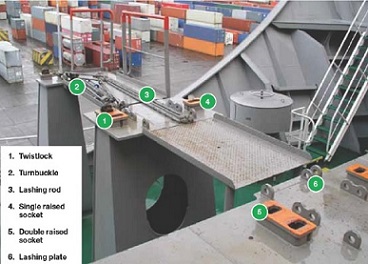
typical arrangement of container lashing
containership lashing pattern
Other factors should be taken into account before accepting a containership cargo stowage plan, :
Stacking Weights
Prior loading cargo, stacking weights of containers must be checked against the allowable stack weights on board the vessel both on deck and under deck. Neglecting above may cause serious damage to ship structure and hull, and eventually, the overall stability of the ship may be affected.
....
Dangerous goods stowage and segregation
After confirming acceptability of the DG cargo, the plan must be checked for proper stowage and segregation. Although terminal and central planners should provide proper stow of DG cargo, the final responsibility always lies with the MasterMaster.
…
Reefer Container Stowage
Stowage location of reefers must be checked against vessels reefer receptacle locations. In case reefer containers must be loaded in random locations, it must be confirmed that monitoring and repair will be possible during the voyage. That vessel has sufficient extension cables for providing power. ....
Out of Gauge Container Stowage
Out of gauge containers are usually stowed underdeck and in case of an On Deck Stow, careful consideration will be required. Local planner or agent may be requested for such approval prior loading.
....
Special Container Stowage
When stowing high cube containers on deck, visibility from bridge must be considered in case several high cube containers are in the same stack.
When stowing these Under Deck, Hatch cover clearance must be considered.
....
How to check Irregular Stowage of Containers
Stacking Weights
Lashing Strength
Special Container Stowage
Over-stow of Containers
Dangerous Cargo Stowage & Segregation
20 or 40 or 45 feet Compulsory Stowage Locations
....
Over-stow of Containers
The duty of the Terminal planner/ Central planner is to carefully plan the loading on board so as to ensure minimum or no overstow of containers that will require to be re-stowed at subsequent ports.
.....
Hatch Cover Clearance (High cube containers Under Deck )
Hatch Cover Clearance (High cube containers Under Deck )
Hatch cover clearance must be checked carefully in case of loading over height containers or high cube containers underdeck.
.....
ShipsBusiness.com is merely an informational site about various aspects of ships operation,maintenance procedure,
prevention of pollution and many safety guideline. The procedures explained here are only indicative,
not exhaustive in nature and one must always be guided by practices of good seamanship. Site Use and Privacy - Read our privacy policy and site use information.
//Home //Terms and conditions of use