Preventing Accidents In Engine Room- Standard Working Procedure
Many accidents have been reported in the ship's engine room due to engine failures or loss of power and the substandard working procedure. Poor housekeeping and many other safety issues that can be resolved would help improve the overall safety culture of a ship. Summarized below are some necessary safety precautions for working onboard machinery spaces. These procedures are only indicative, not exhaustive and one must always be guided by practices of good seamanship
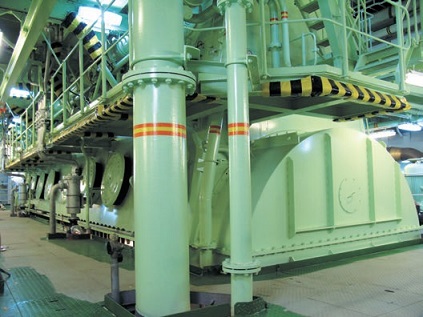
Fig: Engine room arrangement -Main engine floor
Oily contaminated materials:
All oil contaminated rags and other material shall be placed in metal containers and disposed of ashore when required (no dumping or incinerating).
Bilges:
All pipe or pump leakages shall be repaired as soon as possible to limit the amount of bilge water that needs separation and eventually discharge overboard.
Engine Room Workshop:
The engine room shall be kept tidy to allow hot work when required. No storage of flammable material is permitted. The personal protective equipment (PPE) shall be prepared in place.
Special attention shall be paid to the following in the engine room:
Floorplates and ladders shall be free form oil or grease and be properly fixed to avoid tripping;
Exhaust manifolds on engines shall be properly insulated and protected by metal;
Exhaust manifolds and ducts through the entire casing shall be free from leakages;
When engine room is unmanned external entrances to the engine room shall be locked except designated entrances;
Steam pipes and other hot surfaces shall be properly lagged;
Insulation contaminated by oil or other flammable products shall be renewed;
No flammable material shall be left in buckets or open containers;
Short sounding pipes and automatic closing arrangements shall never be left open;
Bunker tank high level alarm shall be tested before each bunkering operation and at least monthly;
Leakages of fuel and lube oil shall be contained as soon as possible;
Thermometers and pressure gauges shall be tested and calibrated on a sequential basis allowing all to be tested annually;
Areas around fuel and lube oil heating and separating areas shall be kept free from any accumulation of oil;
The operation of the bilge water separator shall be strictly supervised by the Chief Engineer;
If any part of the fire detection system is temporarily disengaged due to any repair, e.g. hot work in the area, this shall be clearly mentioned on the work permit;
All rotating parts shall be kept protected;
Smoking is not allowed in the engine room; and
The incinerator shall be used as per manufacturer guideline
Monthly Safety Inspections to be carried out
Merchant Shipping regulations require every dangerous part of a ship's machinery to be securely guarded unless it is so positioned or constructed that it is as safe as if it were securely guarded or is otherwise safeguarded.
The ISM Code requires companies to adopt a Safety Management System (SMS) and ensure the SMS is understood by staff, including training and guidance for safety systems.
Engine rooms by their very design are hazard areas to the unwary or unfamiliar for all sorts of reasons automatically starting machinery, loud noises, loud alarms, poorly indicated or signposted escape routes, 'blind' areas with no exit, etc.
It is suggested that engine room emergency escape doors and exit routes should be clearly highlighted using a fluorescent colour such as 'day glo' orange or yellow or painting the door with 'tiger stripes'.
Whatever paint is used it should be a water based paint rather than an oil based so as not to affect the properties of the class 'A' fire doors that are always fitted to the engine room exits.
Any door that leads out from the engine room is effectively an 'emergency exit.' Some ladders in an engine room lead only to half decks where measurement equipment or gauges are located, and these areas may not lead to an escape route, so they should be marked with a conspicuous NO EXIT sign.
The most common escape route is the vertical trunking from various levels in the engine room, usually located forward and leading onto the open deck or right aft from the stern tube area up to the airlock doors between the engine room and the steering flat door.
In the event of the engine room being filled with smoke, even light smoke, the escape routes and doors from the engine room may be obscured, and therefore they should be more clearly indicated.
ShipsBusiness.com is merely an informational site about various aspects of ships operation,maintenance procedure,
prevention of pollution and many safety guideline. The procedures explained here are only indicative,
not exhaustive in nature and one must always be guided by practices of good seamanship. Site Use and Privacy - Read our privacy policy and site use information.
//Home //Terms and conditions of use