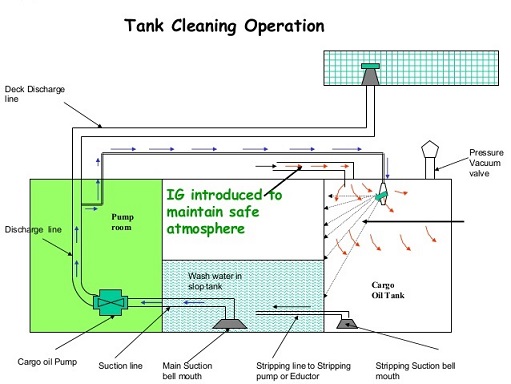
Tanker operation : crude oil washing procedure Prior operating crude oil washing onboard utmost diligence in planning and most careful consideration will need to be made for a safe working area. Following are the basic guidance for quick reference . Supervision Of Crude Oil Washing (COW) Operations The Chief Officer, as qualified by the requirements as laid down by flag state administration of the ship and any port regulations that may be in force locally, shall supervise all COW operations. If the Chief Officer is less experienced, the qualified Master shall assist in the supervision of the operations. He shall be knowledgeable about the contents of the Operations and Equipment Manual. The Chief Officer shall prepare a detailed cargo oil discharge and Crude Oil Washing Plan prior to arrival discharge port. He shall carry out the operations in accordance with the plan. Reference should also be made to the latest IMOs publication Crude Oil Washing Systems and ICS/OCIMFs publication- the ISGOTT. The Master, Chief Officer, Chief Engineer and other officers engaged in Crude Oil Washing shall be fully familiar with the crude oil washing system provide on board the vessel. Fig:Oil tanker Golden Victory underwayDischarging Strategy The discharge sequence is to be such that the vessel has a good draining trim at an early stage in the discharge. This will allow early effective stripping. When planning for COW, the frequency and time of removing the cargo pumps from discharge operations should be planned for minimum, for efficient discharge. Terminal (Refinery) request Special details, port requirements and special precautions or procedures should be discussed with all personnel involved in the discharge operation. (eg. any special requirements for final discharge of crude (Fresh or Dirty) prior to completion of discharge operations, etc) COW Manual Crude Oil Washing and related operations shall be carried out in accordance with the Operations and Equipment manuals (COW manuals) approved by the class on behalf of flag state Government and provided on board each ship. Advance Notice In Port Where it is required to carry out crude oil washing during cargo discharge, the Master should inform the terminal and seek terminals permission. The same shall be discussed in detail, prior to start of cargo operations in the Pre cargo transfer safety meeting held with the terminal. COW should proceed, only after terminals permission is granted. For crude oil washing carried out in Japanese ports, the Master shall obtain approval of the Charterer, consignee, unloading terminal, harbour master and others. Safety Measures For Crude Oil Washing Operations For crude oil washing, the Chief Officer shall carry out the following safety matters and shall also observe the safety regulations on crude oil washing provided by the terminal (if any). Some terminals require the vessel to complete the terminal specific safety Questionnaire / Permit / Checklists prior to granting permission for approval. In addition, he shall follow the safety precautions as laid in the relevant section of the Latest version of ISGOTT. The following shall be not used and isolated prior to carrying COW: Between tank cleaning lines and overboard discharge or Engine Room a) Tank Cleaning Heaters (to be blanked) b) Overboard Discharge Lines (to be isolated) c) Portable Washing Machines (not to be used for COW and their hydrants blanked) d) Cargo Sea Chests (to be blanked) Pressure Test before Arrival Port Conduct pressure test of COW lines prior to arrival. Any leakages, must be rectified and the system, re-tested to be proved leak free. ![]() Confirming Atmosphere in Tanks to be Crude Oil Washed Prior to commencement of COW operations ensure that the oxygen content of the cargo oil tanks being washed is below 8%. Refer to Cargo Oil Tank Oxygen & H2S monitoring Record for Voyage of Double Hull Operation and Oil Tank Monitoring Record. During COW operations ensure that the cargo oil tank pressure is minimum 200 mmAq and that the IGS produces inert gas with an oxygen content of less than 5%. Prevention of Electrostatic Generation Do not use crude oil containing water, as washing oil. Note Mixtures of crude oil and water can produce electrically charged mist, during washing with an electrical potential considerably in excess of that produced by Dry crude. Refer to the relevant section in ISGOTT for precautions for Static Electricity generation and its hazards. Before using such oil as a source of crude oil for washing, any water which has settled down during the voyage must be de De-bottomed (by discharging) to terminal by at least one meter in depth. Where load-on-top method has been used for cargo in slop tank (previously containing oily water mixtures), the whole cargo oil in that slop tank which needs to be used as a source of oil for crude oil washing must be discharged ashore and then refilled with fresh crude from other tanks. Communication equipment Ensure only intrinsically portable radios are used on deck during COW operations. Deck crew shall be in prompt communication with Duty officer & chief officer. Suspending Crude Oil Washing Suspend COW operations immediately if: a) The oxygen content of Inert Gas being supplied exceeds 8% by Volume. b) Malfunction or stoppage of IG system where the internal pressure of the cargo oil tank can become negative. c) Any indication of cargo oil leakage or malfunction in the COW system. d) COW operation is not carried out in accordance with the COW operation plan, or if communication between the CCR and main deck is lost. e) Discharge operations are to be suspended due to lightening in the vicinity of the vessel. f) If the required necessary safety precautions as described and covered above cannot be followed. g) If terminal instruct to do so Prevention Of Air Pollution Follow the Precautions Against Air Pollution to minimize petroleum vapor emissions Crude Oil Washing Plan The Chief Officer shall prepare a detailed COW plan in accordance with the Crude Oil Washing Plan in order to carry out the COW operation in the most safe and efficient manner. Prior to arrival of the Port, or at the earliest opportunity thereafter, the Chief Officer shall conduct a Pre transfer cargo safety meeting with all personnel involved in the COW operation to ensure that all have read and fully understand the plan. Personnel Arrangement For Operations Carry out Crude Oil Washing by the adequate personnel arrangement as per COW plan under the reference of the Personnel Arrangement for Crude Oil Washing Points Of Crude Oil Washing COW operations shall always be carried out in accordance with the Crude Oil Washing Operations COW operations for High Viscosity & High Pour point (Heated) cargoes shall always be carried out in accordance with the Crude Oil Washing of Heated Cargo Recording The Chief Officer shall ensure that the following records are kept during COW operations: a) Crude oil washing check list b) Oil record book: According to the Procedures for Entry in Oil Record Book c) Deck logbook : Date and time, and results of a COW line pressure test and operation test of related equipment. d) Crude Oil Washing Record e) Cargo Oil Tank Oxygen & H2S monitoring Record for Voyage of Double Hull Operation and Oil Tank Monitoring Record: It is the Measurement record of oxygen level in tanks Before entering Load port, After loading cargo, Before entering discharge port and Before crude oil washing. f)Inert gas record : Log for 4 hourly IG pressure monitoring of cargo tanks, in addition to Continuous pressure recording by fixed recorder of IGS main line pressure after loading, until completion of discharge. Regulations For Reference MARPOL 73/78 Convention, ANNEX I Laws on Prevention of Marine Pollution and Sea Disasters (Japan) OPA90, CFR (US) Documents For Reference IMO-Crude Oil Washing System, (Latest edition) IMO-Inert Gas System, Latest edition ICS / OCIMF - International Safety Guide for Oil Tankers and Terminal (ISGOTT) (Latest edition) Related topics: Oil pollution control method Gas freeing arrangement for oil tanker Handling guideline for oil cargo Oil pollution prevention method Preparation for loading oil cargo How to prevent spillage of oil cargo General precautions for oil cargo loading in tankers General precautions for tankers General guidances for tank cleaning General precautions for ballasting procedure Tanker operation in a laden voyage Preparation for discharging oil cargo General precautions for oil cargo discharging Other Info Pages Our home page Ship to ship transfer procedure Cold district countermeasure Pumproom procedure Tanker operation Inert gas system Inert Condition Tanker precaution Sounding of tanks Oil loading preparation Site Map Site Use and Privacy Contact us Copyright © 2009 Ships business.com All rights reserved. |
|