Containerships Lashing Requirements & Care Of Lashing Devices
There are six degrees of motion at sea that a ship may have to encounter in a voyage. However, pitching, heaving, and rolling are three major forces that impact most on a containership's lashing arrangement. Lateral rolling motion factors the greatest challenge for piles of containers. If containers are to be carried safely on the deck of a container vessel, they must be tightly connected to the ship. It is done with the aid of devices known as twist locks.
These twist locks are inserted into the corner castings of the containers. These corner castings have elongated holes where the rotating lug of the twist-lock engages, locking the containers together. Besides, the base two layers of the stacked containers are attached to the vessel with lashing rods. Initially, it was a common system to stow stacks of containers on the deck so that the individual stacks were connected laterally using special storage equipment.
In contrast to this, nowadays, each stack occupies in unique so that it can be stowed or discharged individually of neighboring stacks. A vessel shipping container on deck thus transports a kind of "forest "of self-supporting towers which, in rough seas, sway back and forth due to the substance's flexibility in much the same way as the ears of corn.
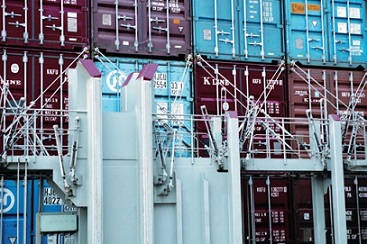
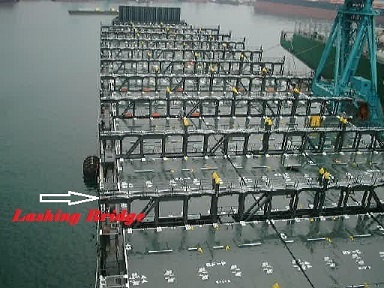
Typically, lashing rods are arranged crosswise in front of and behind each container stack and absorb lateral movements of the pile. Depending on the predetermined height of the container stacks on deck, and their allowed weight, the fifth layer of stacks is, for example, secured at the bottom by lashing rods. To enable these rods to be attached, ships have what are known as lashing bridges running over the vessel between the rows of cargo. The stevedores can stand on these to work and fasten the rods.
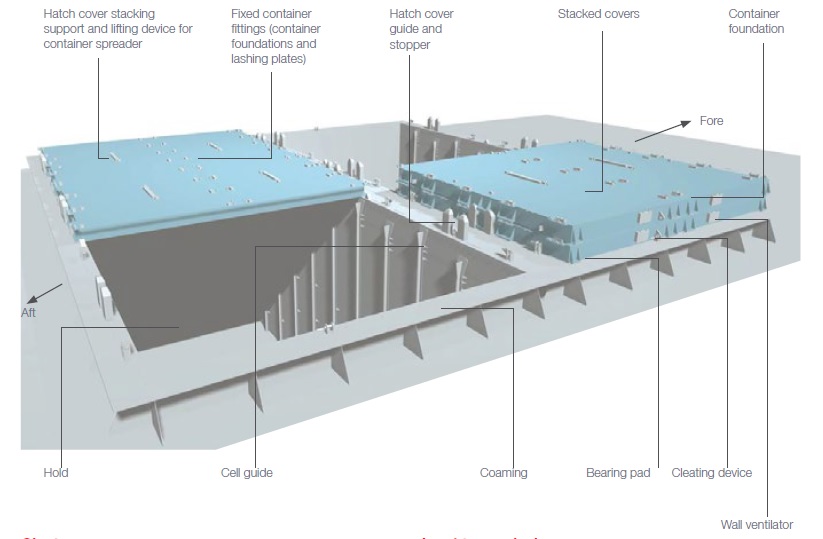
Containers loaded under the deck in cellular vessels are constrained by the cell guides, landed one on top of
the other, and require no further securing. A considerable number of ships also have cell guides that extend
above the weather deck, and they too require no further securing. Containers stacked one above the other
without the benefit of cell guides must be secured one to the other with twist locks, and/or a combination of
locating cones, bridging pieces, lashing rods, wires, and bottle screws to prevent shifting.
Securing containers on (or, if applicable, below) deck is the ship's staff's responsibility
though not necessarily carried out by them whether the ship is a purpose-built container ship or another
type of ship carrying containers.
all rod and wire lashings must be sufficiently tight but not
too tight to strain fittings, containers, etc. The correct bridging pieces, twist locks, etc., should be checked in
position between tiers. It should be ascertained and clearly understood by both ship's and shore staff which
way twist-lock handles are turned for locking, i.e., the locking position should be in the same direction for
all twist-locks on the ship so that a glance will ensure that the locks are indeed engaged.
Recent concerns over losses of containers from large container ships have focused particular attention
on fully-automatic twist-locks and the possibility of such equipment's failure. Research has indicated that
fully-automatic twist-locks may be susceptible to disengaging when subjected to the large dynamic forces
experienced by large containerships operating in heavy seas. Contributory factors may be mixing
containers of different dimensions and the effect of endeavors to reduce handling costs.
Ships' staff should
ensure that all lashings required in accordance with the ship's lashing plan are put in place to minimise the
possibility of losses. Additionally, there may be occasions when planners seeking to minimise container
moves give heavy units top stow. This may not only cause stability problems, but excessive lashing strains
when rolling, pitching or working in a seaway. While some of these factors may be outside their control, ships'
officers should be alert to improper stowage and not hesitate to bring it to the attention of ship planners.
container stowage
With the increased height of containers stowed on deck (up to eight tiers) the problem of safely securing
the stacks has now been addressed with the construction of substantial steel lashing bridges which may
extend to a height of three tiers above the deck and thus enable the tiers above to be lashed to a secure
structure with the added benefit of providing a safe platform for personnel engaged in lashing.
The blocking of containers in stow with unitized or general cargo has already been mentioned and to facilitate this and spread the load on the container sides; large inflatable dunnage bags might be used to advantage.
Containers that are not blocked in must be adequately secured with wire, rod, or chain lashings to prevent
movement and reduce the racking strains on the box. When lashing containers in conventional
stow or on deck, particular attention must be paid to securing the bottom of the container and the
top corners. This is particularly important if two or more boxes are stowed in a vertical stack. It is
also important that only the corner castings are used to secure the container. A wire lashing passed over
the top middle section of a box does not ensure it adequately and will damage the container should
it move. Ships that have been designed to carry containers either below or on deck but do not have cell
guides will have deck fittings suitably placed for corner castings to be held. Container shoes, stacker cones, and twist-locks must be appropriately maintained. Twist-locks must be correctly engaged,
usually by rotating the locking mechanism through 90°. The shipbuilder's lashing plan
should be strictly adhered to, particularly when containers of varying heights are loaded.
All container
securing equipment (chains, rods, twist locks, shoes, cones, etc.) must be inspected at regular intervals
with maintenance carried out as necessary with appropriate records maintained. In large ships, this may
be impossible for the ship's staff to carry out, and owners should make appropriate arrangements. It
may be necessary for the equipment to be landed for inspection by adequately trained personnel in a shore
establishment.
Ro-Ro ships that may carry cargo either on wheels or landed directly on the deck will usually be fitted
with securing points that can be used for either type of cargo.
Cargo Securing :
It is essential that before proceeding to sea, all cargo on board is adequately secured to prevent it
moving and endangering the safety of ship and crew. Particular shipments and specific ship types may
require specialized securing and the IMO Code of Safe Practice for Cargo Stowage and Securing, 2011,
(CSS Code) guides stowage and ensuring of particular commodities (e.g., portable tanks,
wheeled cargo, locomotives, coiled sheet steel, metal scrap in bulk, logs, etc.
Additionally, the Code provides guidelines for the preparation of a Cargo Securing Manual "… appropriate
to the characteristics of the ship and its intended service…" This means that each ship must be provided
with a manual that is written for that particular ship. Information in the manual must include:
a. details of fixed securing arrangements and their locations;
b. locations and stowage of portable securing gear;
c. details of portable securing gear including an inventory;
d. examples of the correct application of such gear;
e. indication of the transverse, longitudinal and vertical accelerations to be expected in various
positions on board the ship.
It is not possible for ships' staff to examine or monitor the securing of cargo within a container although
the Master has the right to open a container for inspection should he suspect that all may not be well
within. Cargo which is visible (such as that on flatracks) can be examined prior to loading and any lashing
arrangements which are suspect may be adjusted or the unit rejected until properly secured.
Fig: Containership lashing pattern
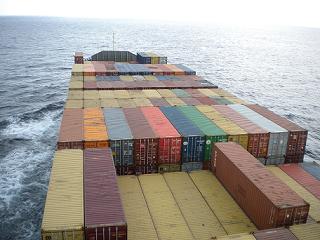
Containers stowed on deck require particular care in stowage and securing while also
affording adequate access to sounding pipes, fire hydrants, etc., and to the ship's side should the need
to jettison arise. At sea, all containers on deck should be inspected daily, and lashings tightened when required.
In general, it is not desirable to carry steel cargoes on deck (including in flatrack containers) as they are
particularly susceptible to the moist salt air and maintaining covering in heavy weather often proves
impractical.
When containers are carried on deck, the ship is required to be approved for that purpose; and containers themselves are fastened with twist locks and lashings. These usually consist of steel rods and turnbuckles. Lashing design to be followed on board is detailed in the vessel's cargo securing manual.
When containers are carried below deck, the containers are slotted into cell guides on a cellular container ship. When carried within a cell guide framework, no further external support is generally required.
When 20' containers are stowed below deck in 40' cell guides, it may be necessary to over-stow the 20' containers with a 40' container. The Cargo Securing Manual should be consulted before loading.
Vessels lashing requirements as per the cargo securing manual must be informed to the terminal staff, stevedoring company as required. If necessary, copies of the Lashing Patterns must be provided.
There must be a clear understanding of the vessels lashing requirements to avoid delays and non-compliance with cargo securing requirements.
Unused cargo loose securing devices after discharging containers must be stowed away safely in designated lashing bins on deck. After cargo operations are complete, it must be ensured that no loose securing devices are lying on container tops, hatch covers or such places to pose a potential threat of injury or damage.
Fig: Lashing bridge
Ships lashing gear must be well cared for, and crew must always be vigilant to avoid loss of lashing material. These are mainly lost due to pilferage, damage, gear being left on the quay and not returned on board and twist locks remaining on discharged containers carried away to the yard.
Lashing bridge – A strong steel structure installed between hatches to permit the storage
of an additional tier of containers or more substantial containers in the upper tier. Lashings can be
applied at a higher level but can also remain short.
Container lashing
Certified container lashing components must be in place for the safe and efficient lashing of containers.
Defective equipment must be replaced immediately. It must be ensured that deformed hooks are not used.
It is also dangerous to overlook the wastage of steel to secure devices that would reduce the lashing arrangement's strength.
Crewmembers should ensure that the lashings are well maintained and lashing devices are kept in good condition.
Stevedores are usually responsible for lashing and de-lashing jobs in the port; however, due to lesser port stay and time constraints, crewmembers are also responsible for this operation.
While conducting lashing and de-lashing operations, crewmembers should wear Personal Protective Equipment (PPE), such as a reflective vest, steel toe shoes, hard helmet, gloves, etc.
They should also stretch and warm up their muscles before conducting this strenuous physical job to avoid a muscle pull or injury.
The use of a back support belt is a must during lashing and de-lashing operations, and the crew should be cautious while walking around the ship as the vessel's structure could lead to a tripping hazard.
It is also important for crew members to understand the lashing and unlashing operation plan and order. It should be kept in mind that reefer containers always require more attention and co-ordination for plugging and unplugging during loading or unloading operations.
The lashing patterns are calculated individually for each ship by specialist firms and are inspected and approved by the classification societies. The results of such calculations are recorded in a Cargo Securing Manual approved by the flag state and in which all aspects can be found. The mass of the containers is of critical importance because the higher a box is in a pile of containers on deck, the less it may weigh.
Our additional pages contain somewhat larger lists of resources where you can find useful informations
Our articles are based on various shipboard activities,safe operation,maintenance and onboard procedure. We welcome any feedback from our visitors. For any comments or suggestions please contact us.
ShipsBusiness.com is merely an informational site about various aspects of ships operation,maintenance procedure,
prevention of pollution and many safety guideline. The procedures explained here are only indicative,
not exhaustive in nature and one must always be guided by practices of good seamanship. Site Use and Privacy - Read our privacy policy and site use information.
//Home //Terms and conditions of use