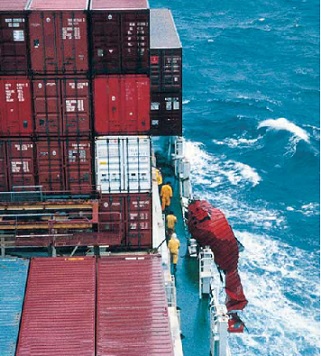
Container Ships Motion in a Parametric Roll - How To Avoid Adverse Affects?
The term parametric roll for a container ship is used to describe the phenomenon of large unstable roll motion suddenly occurring in the head or stern seas.
Due to its violent nature, the large accelerations associated with the onset of the parametric roll cause concern for container ships' safety. Possible consequences include loss of containers, machinery failure, structural damage, and even capsize.
Parametric roll is a "threshold" phenomenon.
This means that a combination of environmental, operational and design parameters needs to occur before it is encountered.
The ship would be traveling with a small heading angle to the predominant wave direction (head or stern seas).
Wavelength would be comparable to ship length.
Wave height would be large.
The ship’s roll damping characteristic would be low. If unfavorable tuning occurs between wave encounter period and natural or twice natural roll period of the vessel, then parametric roll motion can be experienced.
Large Containerships due to
their hull form might adversely
affected by parametric rolls
Why are large container ships vulnerable to
parametric roll ?
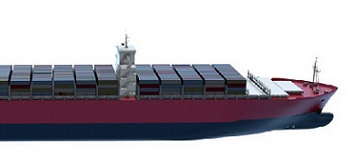
This is because they have hull forms with pronounced bow flare, flat transom stern, and wall-sided mid-ship section.
Such features contribute to the variation of the ship's stability characteristics due to the constant change of the underwater hull geometry as waves travel past the ship.
Although this phenomenon has been studied in the past, it has only come to prominence
with the introduction of larger container ships. Until the 1990s, it was considered critical
only for ships with marginal stability and fine-lined warships.
Consequences of a Parametric Roll
Parametric roll is an extreme condition for container securing since it combines the effect of large roll and pitch amplitudes. This scenario imposes significant loads on container securing systems.
Such extreme roll angles exceed those usually adopted during machinery design.
Possible consequences on machinery operation of the ship heeling to very large angles include loss of cooling water suction, exposure of lubricating oil sumps– and hence shut-down of the main engine.
Large containership hull form
The following points should be borne in mind:
Parametric roll is a relatively rare phenomenon occurring in the head or following seas, which is characterized by rapidly developed, large, unstable ship rolling.
Risk control options exist in both design and operation of container ships that can effectively reduce the likelihood of a parametric roll occurring.
Reducing the likelihood of its occurrence is considered a more practical approach than mitigating the consequences.
Master should be aware that, when conditions for parametric rolling exist, putting the ship's head to the sea and reducing speed could make rolling worse.
The North Pacific in winter is known to be an area where conditions for parametric rolling exist.
Parametric roll prevention system (IPRP)
The anti-heeling system developed by the
German company InteringTM to prevent the build-up of parametric rolling in the head or
following seas. Sea-keeping model tests demonstrate that the system can reduce the risk of parametric disturbance by shifting the critical wave threshold to such high values that the chances of ever encountering such a roll during a vessel service life are meager.
A typical example of a complete ship system will include several pairs of U-shaped tanks.
Moreover, pneumatically controlled air valves, plus a control unit with pitch and roll sensors.
The controller detects the starting phase of parametric rolling and tunes the tank water
period and its damping characteristics by operating the valves according to the actual
ship motion.
With the metacentric height reduction of appr. 10%, the system will prevent from
excessive parametric rolling in significant wave heights up to approx. 10m event at zero
speed.
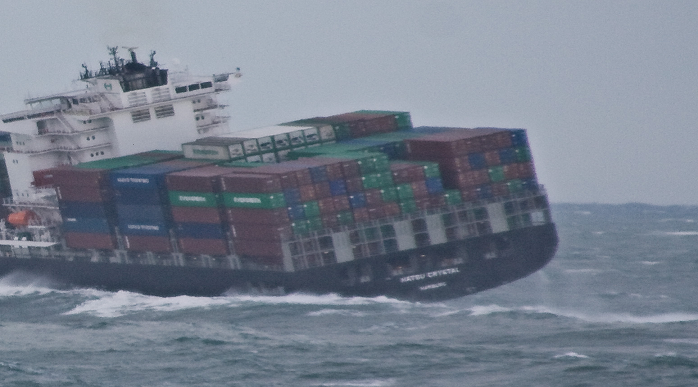
Fig: Loss of containers due parametric rolling
Parametric Rolling Causes Loss of Containers
In a case study published by UKMAIB - A container vessel loses 50 containers while encountering parametric rolling. The vessel altered course after facing heavy weather, but conditions remained precarious. Anxiety grew as the height of the waves, and the pitching and rolling of the vessel increased. Speed was decreased. An extraordinary roll of about 30 degrees parted the lashings, resulting in 50 containers being lost overboard and effecting the vessel to list to port. The vessel was hove to, and a starboard ballast tank was filled to bring her closer to the upright. Some flooding of forwarding spaces was prompted by wave damage to ventilation pipes when the vessel was hove to, but she reached port without further problems.
This phenomenon of parametric rolling was due to the pitching motion that excites the natural rolling frequency, leading to large angles of heel.
How this happened?
The origin of the problem lies in the hull configuration of container ships. They have to be agile, hence the fine lines forward, but also they have to have their deck area maximized, hence the full hull shape aft. An initial angle of heel is needed to get the mechanism going. This will normally be caused by wind storming against one side. There will be an imbalance of buoyancy at the aft end with a heel's angle because one side of the aft end will be more fully immersed. The imbalance of buoyancy will increase when the ship pitches stern down, and conversely, the imbalance will be released when the ship pitches with the stern up. The rolling motion will be excited if the pitching frequency is similar to the natural rolling frequency.
Lessons
Bridge crews of large container vessels should be conscious of the parametric rolling phenomenon. Changing course and/or speed is a way of separating the pitching and rolling frequencies.
This vessel was fitted with a computer system that could prognosticate when parametric rolling was likely to be a problem. This tool was used when the heavy weather was encountered, and, as a result, the ship was slowed. However, the master believes that parametric rolling produced exceptional roll; therefore, the computer system did not provide good information. Such systems may give a misleading sense of security. Source: UKMAIB
Ships turning circle and manoeuvering characteristics
Ship manoeuvering-turning circle advices
A deeply laden vessel will experience little effect from wind or sea when turning, but a vessel in a light or ballasted condition will make considerable leeway, especially with strong winds.
....
Various factors affecting ships turning circle while manoeuvering
When a vessel fitted with a right-hand fixed propeller, she would benefit from the transverse thrust effect, and her turning circle, in general, will be quicker and tighter when turning to port than to starboard.
....
External factors that affecting ships turn
The deeper a vessel lies in the water, the more sluggish will be her response to the helm. On the other hand, the superstructure of a vessel in a light condition and shallow in draught is considerably influenced by the wind.
....
Ships navigation -Factors Affecting Turning circle diameter
Merchant ships usually turn in a circle having a diameter of about 3–4 times the length between perpendiculars (LBP). The larger the rudder, the smaller will be the Turning circle diameter(TCD). During the TCD manoeuvre, the ship will experience transfer, advance, drift angles and angle of heel (see Figure )....
ShipsBusiness.com is merely an informational site about various aspects of ships operation,maintenance procedure,
prevention of pollution and many safety guideline. The procedures explained here are only indicative,
not exhaustive in nature and one must always be guided by practices of good seamanship. Site Use and Privacy - Read our privacy policy and site use information.
//Home //Terms and conditions of use