Navigational guidance for the officer of the watch- Cargo ships procedure
Bridge watchkeeping is the most critical activity conducted at sea. Upon the watchkeeper's diligence rests the safety and security of the ship, her entire crew, the cargo, and the environment.
It is a demanding activity, requires support, encouragement, motivation, self-discipline and a high standard of professionalism. Ships master must ensure that all watchkeepers understand the use of safety related equipment, prior to them keeping a watch.
Reference publications applicable for keeping safe navigational watch at sea:-
Bridge Procedures Guide (ICS) - This guide is an essential part of the Company's instructions, and its contents must be understood by all bridge watchkeepers.
International Regulations for Preventing Collisions at Sea (1972 as amended)
It is essential while navigating ships, the officer of the watch understands practical procedures to avoid collision guided by masters standing orders. These procedures are only indicative, not exhaustive, and must always be guided by practices of good seamanship.
The watch (OOW) officer shall comply with masters' standing orders (including any supplementary instructions) to carry out the navigational watch. He must always bear in mind that he is the Master's representative and has primary responsibility at all times for the safe navigation of the ship and for fully complying with the latest COLREGS
It is essential to keep a
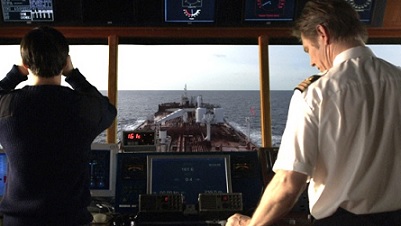
proper lookout by all means
The OOW shall read the Master's instructions written in the Master's Order Book carefully and affix his signature before taking over the navigational watch.
The OOW shall perform his bridge watch duties, and shall not leave the Bridge unless adequately relieved by the Master or another qualified officer.
The OOW shall not transfer his duty if he doubts whether the relieving officer is physically and mentally capable of carrying out his duties effectively.
Instead, he shall advise the Master.
The OOW shall call the Master immediately, if he is in any doubt regarding navigation, or if the vessel falls into any of the situations specified in the "List of Conditions to be reported to Master"
The relieving officer shall take over the watch after he has confirmed all items in the "Navigational Watch Transfer Checklist"
The OOW shall maintain a strict and constant lookout primarily by Sight, and use Binoculars, day and night.
The OOW shall observe the compass bearing of all approaching targets to determine if the risk of collision exists.
When an OOW is to be relieved who engaged in a maneuver or a VHF conversation, relief should be deferred until such action is completed.
The OOW shall pass other vessels, obstacles, fishing nets, and the like, keeping wide berth as far as practical.
Required CPAs (Closest Point of Approach) are as follows.
Passing other ships at a safe distance as per the prevailing circumstance
Overtaking a ship at a safe distance as per the prevailing circumstance
Crossing the course of a ship at a safe distance as per the prevailing circumstances
Avoid Obstacles and fishing nets
The OOW shall be well aware of the use of the Main Engine in an emergency so that he may use the Main Engine without hesitation as required.
The OOW shall use sound signals, such as Warning signals, Maneuvering signals, and Fog signals, without hesitation even at night.
In waters where the danger to navigation exists in addition to the above items 13 and 14, the OOW shall post a Helmsman enough in advance, and change to Manual Steering when necessary.
The OOW shall always confirm proper steering by the Helmsman or Automatic pilot.
The OOW shall confirm the vessel position regularly. If the position is made by an electronic navigation system, he shall verify the same by land fix, if available.
If a scheduled time for plotting a fix or altering course has arrived, the OOW should first ensure that lookout or an evasive maneuver is not compromised.
The OOW shall compare the indication of the Gyro compass with that of Magnetic compasses on setting or alteration of course and after that, check once every hour at least.
The OOW shall measure Errors of the Gyro and Magnetic compasses at every watch and log the same, including the reason for the inability to check error.
The OOW shall check the repeaters of the Gyro compass (including output to RADAR/ARPA, ECDIS, Course recorder, AIS, etc.) to confirm if they are synchronized with the master compass.
The OOW shall regularly confirm RPM of the main engine and presence/absence of alarm generation. If any abnormality is discovered, it shall be reported to the Engineer on Duty or the Chief Engineer.
The Echo sounder recorder should be switched on before each approach to shallow water, to port entry and before departure, and remain in operation while in shallow waters.
As a guideline, the OOW shall use the Echo-sounder frequently to measure the depth when less than 50 meters and continuously where expected UKC is less than 5 meters.
He shall compare the UKC with figures calculated from chart depths and advise any abnormality.
The OOW shall confirm Navigation Lights and other Regulation Lights, Shape signals, and Whistles are operating correctly.
The OOW shall confirm carrying out onboard patrol .
In addition to the above, the OOW shall comply with the items that require attention for the safety of navigation and prevention of environmental pollution.
For detailed guidance for Navigational duties, reference shall be made to the publications "Bridge Procedures Guide" and "Bridge Team Management."
All instruments' recording paper must be annotated before port arrival /departure and at noon daily, and confirmation done of correct synchronization. Navigational warnings and weather messages must be read and signed by the OOW and brought to the Master's notice.
During pilotage, the OOW shall continue monitoring the vessel's position and keep a lookout like no Pilot is on board and advise Master of any abnormality.
The OOW shall enter in the Bell book, the time of Handing over the "con" of the vessel to Master and the time of taking over "con" from him.
Related Information
ECDIS alarm parameters
Safety Contour: Is to be set to the maximum dynamic draft, plus 10% of static draft. Note that ECDIS will select the next deepest contour contained as an object within ENC....
ECDIS warning procedure
Although many vessels have fitted Electronic Chart Display and Information Systems (ECDIS) on a voluntary basis, its use will significantly increase once passenger vessels, tankers and dry cargo ships begin to comply with mandatory SOLAS requirements for ECDIS.
Admiralty Chart correction procedure
There are currently two methods of carrying out electronic chart corrections, either via Weekly Updates, CD or downloaded weekly from a recognized electronic chart supplier's data. The preferred method will be decided by the Management Office depending on the communications equipment onboard the vessel, but in the majority of cases the lack of internet access will determine the update CD as the best option....
Requirement of ECDIS training and implementation guideline
To ensure compliance with the ECDIS requirement, to ensure that the transition is smooth, equipment installed and Master and Bridge watch keepers are all provided generic and ship-specific ECDIS equipment training before the implementation dates of various type vessel: .....
What are the safe navigational procedure for the officer of the watch?
....
The officer of the watch (OOW) shall comply with masters standing orders (including any supplementary instructions) to carry out the navigational watch. He must always bear in mind that he is the Master's representative and has primary responsibility at all times for the safe navigation of the ship and for fully complying with the latest COLREGS
.....
Guidance on ECDIS- data presentation and performance check standards
Type approval is the certification process that ECDIS equipment must undergo before it can be considered as complying with the IMO Performance Standards for ECDIS. The process is conducted by type approval organizations and marine Classification Societies.
…
Collision avoidance
The Master and all deck officers must be fully conversant with the latest edition and amendments of the International Regulations for Preventing Collisions at Sea. The O.O.W. is to take frequent and accurate compass bearings of approaching ships as a means of early detection of risk of collision. ....
Ships motion at sea and required precautions
Ships are affected by movement in six degrees of freedom; rolling, pitching, heaving, swaying, surging and yawing. Of these, rolling, pitching and heaving generate the highest forces during heavy weather. Read more.....
Stress and Stability Calculation ,draft , trim & free surface effect
The Master shall ensure that the conditions of stability, hull strength, draft and trim of the vessel at sea and on arrival / departure at / from port and during loading / unloading cargo, bunkering and water ballast exchange, have been worked out, to secure safety of the vessel. He shall confirm the safety of the vessel by proper GM, stress and other factors as being within appropriate Limits.Read more.....
Safe anchoring practice
Anchoring into "Deep water" which is defined depth of water is beyond 50 meter, must be carried out with "Walk-back Style, however, on the VLCC operation there exists such a big inertia, Master can treat with Walking-back style even in the anchorage where water depth less than 50m, if following conditions are to be forecasted.
Read more.....
ShipsBusiness.com is merely an informational site about various aspects of ships operation,maintenance procedure,
prevention of pollution and many safety guideline. The procedures explained here are only indicative,
not exhaustive in nature and one must always be guided by practices of good seamanship. Site Use and Privacy - Read our privacy policy and site use information.
//Home //Terms and conditions of use